


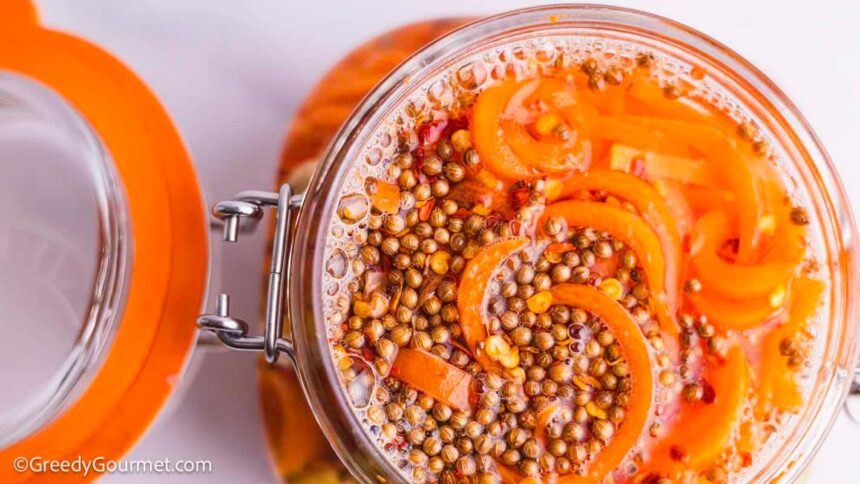
Sharp, gingery pickled carrots with real crunch. Fifteen minutes of work, ready the next day, three weeks in the fridge. Of all my pickle recipes, this is the one to start with.

The Pickled Carrots I Make on Repeat

Fifteen minutes of work, ready by tomorrow. Then they sit in the fridge for three weeks quietly getting better.
Carrot is the ideal thing to pickle, and I have pickled a fair bit, from quick pickled red onions to pickled daikon and courgette pickle. It is sweet and stubborn, so it takes fresh ginger, garlic, chilli and whole mustard and coriander seeds without any one of them shouting over the others.
I had a play with my KitchenAid spiraliser for these photos and it was good fun. The curls look lovely through the glass and they pickle faster than anything else in the jar.
Pile them into a sandwich, especially something rich and cold and meaty. Stir them through salads and grain bowls that want sharpening up. Heap them onto toast with soft cheese and black pepper. Or eat them standing at the fridge with a fork, which is how most of mine go.


Print
📖 Recipe

Pickled Carrots
Description
Sharp, gingery carrots with real crunch, in a hot apple cider vinegar brine with garlic, chilli and whole mustard and coriander seeds. Fifteen minutes of work, ready the next day.
Ingredients
Units
Scale
- 500 g carrots, scrubbed not peeled, cut to a single thickness
- 2 garlic cloves, lightly crushed
- 2 tbsp fresh ginger, sliced
- 2 tsp chilli flakes
- 2 tsp mustard seeds
- 1 tsp coriander seeds
- 2 bay leaves
For the brine
- 250 ml apple cider vinegar
- 250 ml water
- 1 tbsp salt
- 1 tbsp sugar, optional
Instructions
- Pack the carrots into a clean 1 litre jar with the garlic, ginger, chilli, mustard seeds, coriander seeds and bay.
- Combine the vinegar, water, salt and sugar in a small saucepan. Bring to a gentle simmer, stirring until dissolved.
- Pour the hot brine over the carrots to cover, leaving 1 cm at the top.
- Cool to room temperature, lid on, into the fridge.
- Give it 24 hours. Best from day three.
Notes
- Use a vinegar that says 5% acidity on the label. The acid is what keeps this jar safe, so it is not the place to economise. Skip seasoned rice vinegar, which is watered down with sugar and salt.
- Allow 24 hours before eating. The flavour is better from day three.
- Keeps 3 weeks in the fridge. These are refrigerator pickles, not shelf stable.
- Prefer it less salty? Drop the salt to 1 tsp. The jar is kept safe by the acid, not the salt, so this is purely a taste call and nothing else changes.
- Doubling the recipe? Double the spices with it. They scale with the carrot, not with the jar.
- Carrots want a scrub, not a peel.
- One garlic clove per 250 g of carrot is plenty. More bullies the ginger.
- They do not freeze. Good flavour, ruined texture.
The nutrition below is calculated on everything that goes into the jar, brine included. Most of that salt stays in the liquid and gets poured away, so a drained serving carries a good deal less sodium than the figure suggests.
- Prep Time: 15 minutes
- Cook Time: 5 minutes
- Category: Condiments
- Method: Stovetop
- Cuisine: British
How to Pickle Carrots: It Starts With the Cut

Any of these will do it, and the shape is up to you.
One rule only: every piece in the jar wants to be the same thickness.
Thickness is also your crunch dial, the same lever that keeps my quick pickled cucumbers snappy, and it decides when the jar is ready. Fine curls are good in a few hours, matchsticks want a day, thick coins want two. Cut thin and eat them this week. Cut thick and they will still have snap at week three.
Variations Worth Making
Dill and garlic. Swap the mustard and coriander seeds for a few sprigs of fresh dill and an extra clove of garlic. It takes the jar somewhere older and more European, closer to a deli pickle than a spiced one.
Taqueria style, or escabeche. This is the one that turns up in a jar on the counter of a Mexican restaurant. Use white vinegar instead of cider, cut the carrots into coins, and add sliced jalapenos, a pinch of dried oregano and a little sliced white onion. Sharper and hotter, and very good on tacos or anything fried.
Banh mi style. Cut the carrots into fine matchsticks and pickle them alongside an equal weight of daikon. Lighter on the spice, heavier on the sugar, and built to go into a sandwich rather than sit beside one. My pickled daikon lives in its own jar, but the two belong together in a baguette.
Whichever you make, the vinegar still needs to say 5% acidity on the label. That part is not a style choice.
What Can Go Wrong (and How to Fix It)
- Soft and floppy. Cut too fine for how long you left them, or peeler ribbons past their first week. Not a fault, just physics. Go thicker next time
- Still woody in the middle. Fat coins that have not had long enough. Give them another day or two and taste again
- The brine does not cover them. Give it a little while before panicking. Most of it is air trapped between the pieces, worst with curls, and it works itself out. Press them under again. If it is genuinely short, top up with equal parts vinegar and water, never plain water, which dilutes the one thing keeping the jar safe
- Slimy or ropy brine, or an off smell. That is spoilage. Do not taste it to check, just bin the lot
- Cloudy brine on its own is a milder thing. Table salt with anti caking agents, hard water and the garlic will all cloud a jar harmlessly. Judge it on smell and texture, not on how clear it looks

FAQs
How long do pickled carrots keep?
Three weeks in the fridge, in glass jars with clean, well fitting lids. Screw the band down properly and check it seats flat, because a lid that sits proud lets the top layer dry out above the brine.
They do not freeze. Good flavour, ruined texture.
Do I need to sterilise the jars?
No. Hot water and washing up liquid, then a proper dry. Sterilising belongs to jars that live in a cupboard for a year, and these are refrigerator pickles, which is why fridge pickles do not need sterilised jars.
Use a clean fork every single time, never the one that was just in the mayonnaise. That one habit does more than anything else to keep the jar good for the full three weeks.
Can I reuse the leftover brine?
Do not pour it away. It is sharp, gingery and already seasoned, so whisk it into a dressing, or use it to marinate chicken thighs and bin the marinade once the chicken is out of it.
You can pickle one more batch of vegetables in it if you bring it back to a simmer first and add more vinegar and salt. Beyond that you are guessing at an acidity you can no longer taste.
Skip the pickled eggs. Acid takes about a week to reach the middle of a yolk, home pickled eggs left out of the fridge have caused botulism, and a brine that has already done one job is the wrong thing to try it with.
Can I keep these in the cupboard instead of the fridge?
No, and please do not. These are refrigerator pickles. Carrots are a low acid vegetable, and making pickled vegetables shelf safe at room temperature is a proper canning discipline with its own tested recipes and kit. This is not that. The acidity keeps this jar safe, and the cold and the three week limit are the backup.
Are these fermented? Are they a probiotic?
No, though the two get muddled constantly. These are quick pickles. The acid comes out of a bottle, it goes on hot, and nothing in the jar is alive. Fermenting is salt and time and bacteria, and that is where live cultures come from. Different jar entirely.
Mine went softer by week three. What happened?
Pectin, the glue holding the cell walls together. Heat dissolves it quickly, and acid keeps chipping away at it for as long as the jar sits there. So week three will always have less snap than week one, and that is the process working normally rather than anything you did.
Commercial picklers get round it with calcium chloride, sold as Pickle Crisp, which cross links pectin and stiffens the cell wall. It does work, and this recipe does not use it. Cutting thicker and eating them sooner gets you most of the way there for nothing.
One thing to ignore: the grape leaf trick. The evidence behind it comes from fermented cucumbers, where the softening enzyme arrives on the cucumber itself. In a hot vinegar jar of carrots there is very little for it to do, so enjoy the bay leaf for what it gives the flavour and leave it at that.
Why is the brine amber rather than clear?
Because apple cider vinegar is amber to begin with and the spices deepen it. Carrots give up almost none of their colour, whatever you may have read, because the orange in a carrot is fat soluble and there is no fat in this jar. Amber is normal. Cloudy is not.