


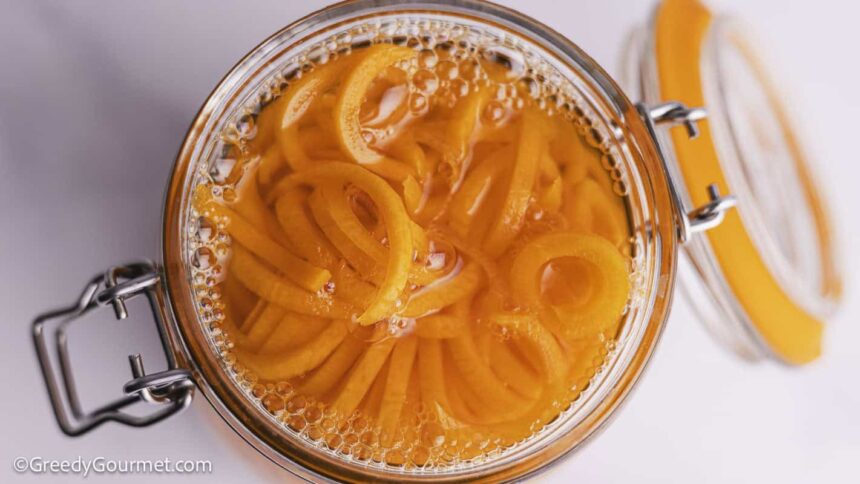
Crunchy, tangy fermented carrots made with nothing but salt, water, garlic and dill. Five days on the worktop, no vinegar anywhere near them, then a month in the fridge. If you have only ever made pickle recipes, this is the jar that changes things.

I Only Made These Because My Degree Told Me To

I would never have made these in a million years.
I am studying for a BSc in Nutritional Therapy at the Institute for Optimum Nutrition, and fermented food comes up constantly. The lecturers extol its virtues. The reading extols its virtues. Everybody in the room seemed perfectly relaxed about it.
I was not relaxed. I was suspicious.
Look at what you are being asked to do. Raw vegetables. Salty water. Left on the worktop, not in the fridge, for the better part of a week. Then you eat them.
Everything I know from years of pickling says the vinegar does the safety work and you can watch it happening. This asks you to trust salt, time, and a jar that looks faintly alive.
I made myself try it anyway. And I lived. Better than that, it was nice. Slightly salty, slightly sour, still with a proper snap.
Then my daughter wandered past, ate forkfuls from the jar, and went back for more. No suspicion, no ceremony, no five days of quietly worrying. Just carrots.
So now I want to ferment everything. Watch this space.


Print

Fermented Carrots
Total Time: 5 days 15 minutes
Yield: 8 servings 1x
Diet: Vegan
Description
Crunchy, tangy lacto fermented carrots with garlic and dill. No vinegar, no canning, just salt, water and five days on the worktop.
Ingredients
Units
Scale
- 500 g carrots
- 2 garlic cloves
- 10 g fresh dill
For the brine
- 500 ml water
- 10 g fine sea salt
Instructions
- Wash a 1 litre jar and its lid in hot soapy water and rinse well. A ferment does not need a sterilised jar the way canning does, but it does need a properly clean one.
- Stir the salt into the water until it has completely dissolved. This gives you a 2% brine, and that percentage is the whole safety mechanism, so weigh it rather than guessing.
- Peel the carrots and spiralize them. A julienne peeler or a coarse grater will do the same job.
- Crush the garlic lightly and drop it into the bottom of the jar with the dill. Pack the carrot curls in on top, pressing down firmly as you go.
- Pour the brine over the carrots until they are completely covered, leaving 3 cm of headspace at the top.
- Weigh the carrots down so that none of them float above the brine. A small glass, a folded cabbage leaf or a proper fermentation weight all work.
- Close the lid and leave the jar out of direct sunlight at room temperature for 5 days.
- Open the lid once a day to release the pressure. Fermenting carrots give off carbon dioxide, and a sealed jar will build up enough of it to pop.
- Start tasting on day 3. Once they taste pleasantly sour, move the jar to the fridge.
Notes
- Nothing may sit above the brine. Anything poking up into the air is where mould starts.
- Cloudy brine and steady bubbling are exactly what you want to see.
- Keeps in the fridge for up to a month, souring gently as it sits.
- Use fine sea salt with no anti-caking agents. Treated table salt can stall the ferment.
- Prep Time: 15 minutes
- Fermenting: 5 days
- Category: Condiments
- Method: Fermenting
- Cuisine: British

Spiralized, Sticks or Coins: Does the Cut Change Anything?
More than you would expect. When people ask how to ferment carrots the salt gets all the attention, and the cut gets none.
I spiralized these with my KitchenAid spiraliser, the same attachment I used for my pickled carrots, and the curls ferment faster than a stick would. More of each carrot touches the brine, so it sours quicker. They also look wonderful through the glass, which matters more than I would like to admit.
You do not need the stand mixer version. A manual spiraliser does the same job for a fraction of the price and a fraction of the washing up, which is the one I reach for when I am only doing a jar or two.
Fermented carrot sticks are the traditional cut and work perfectly well. They want an extra day or two and hold their snap for longer. Coins sit in between and need only a knife.
Whichever you choose, start with firm carrots. Limp ones that have been in the drawer a fortnight ferment soft and slightly sad, and no amount of correct brine will rescue them.
Variations Worth Making
Now that the fear has gone, this is the part I am enjoying most.
- Swap the herb. Coriander seed, caraway or a couple of bay leaves take the jar somewhere quite different.
- Add black peppercorns. A teaspoon alongside the garlic gives a warmth that builds over the five days.
- Add heat. A dried chilli or a teaspoon of flakes. It rounds out as it ferments, so it lands softer than fresh chilli.
- Go gingery. Sliced ginger with a strip of turmeric turns the jar a deep sunset orange.
- Mix the vegetables. Carrot and daikon is the classic banh mi filling and ferments at the same rate. Green beans, cauliflower and radish behave themselves too.
Once this jar has convinced you, the same principle scales up to sauerkraut and kimchi.
What to Serve With Fermented Carrots
Lacto fermented carrots are sharper and saltier than a vinegar pickle, so they cut through rich things.
- With dips. A bowl of them next to beet hummus is how most of ours get eaten. The sourness does the job a squeeze of lemon would.
- In sandwiches and wraps. Anything cold, rich and meaty. They are very good in a lamb sandwich, or piled onto leftover BBQ pulled lamb.
- With pate. They cut straight through something as rich as chicken liver pate.
- Through salads and grain bowls. Scattered over pilau rice, or through a green bean salad, they sharpen the whole thing and save you a dressing.
- On a ploughman’s. Next to good cheese and a spoonful of courgette chutney.
- Straight from the jar. Standing at the fridge with a fork, which is how a fair number of mine disappear.
What Can Go Wrong (and How to Fix It)
- The jar builds up pressure and pops. Nobody warns you about this loudly enough, and it caught me out. Fermentation makes carbon dioxide and a sealed clip-top jar gives it nowhere to go. Leave 3 cm (about an inch) of headspace when you fill the jar so the gas has somewhere to go, and open the lid once a day to let the rest out. If you ferment in Mason jars rather than a clip-top, a pickle pipe is an airlock lid that burps the jar for you and takes the job off your hands.
- A white film on the surface. Almost always kahm yeast, which is harmless. Skim it off and carry on. Fuzzy growth in blue, green, black or pink is mould, and that jar goes in the bin. Kahm is flat and skin-like, mould is raised and furry.
- Soft, slimy carrots. Brine too weak, room too warm, or the carrots were past their best going in. Slimy is a bin job.
- Nothing is happening by day three. Your kitchen is too cold, or the salt had anti-caking agents in it. These are happiest at normal room temperature, somewhere around 18 to 22C. Move the jar somewhere warmer and give it longer. A slow ferment is not a failed one.
- The garlic has turned blue or green. Alarming, harmless, and more common with young garlic. A reaction between compounds in the garlic and the acid in the brine. Everything in the jar is fine.
- It smells strange. A lacto fermented jar smells sour and briny with a faint yeasty edge. That is right. Rotten, cheesy or genuinely foul is not. Sour is good, putrid is not, and your nose knows the difference without any help from me.
- They taste salty but not sour. Not finished yet. Leave them and keep tasting.
- The brine has turned cloudy. Good. That is what success looks like.

FAQs
Will kids actually eat these?
Mine did, and I did not see it coming. I had braced for the sniffing, the suspicion and the face. Instead my daughter ate forkfuls from the jar and came back for more. They are not weird to somebody who has no idea they are supposed to be weird. For the best chance, spiralize rather than cut sticks and pull the jar at day three or four while the sourness is still gentle.
Do the carrots count towards the salt percentage?
This is the most common point of confusion in home fermenting. Some people salt against the water only, which is what this recipe does. Others weigh the vegetables and the water together, the way most sauerkraut recipes do. Neither is wrong, they just give you different jars.
The carrots bring their own water, so a 2% water brine settles to roughly 1.3% once everything equalises, which is a gentle, quick ferment. If you want it firmer and sharper, use 2% of the combined weight instead.
Is it really safe to leave carrots out of the fridge for five days?
Yes, as long as the brine is right and everything stays under it. The salt holds back the bacteria that spoil food while the lactobacillus that sour the carrots get to work. Lacto fermentation is one of the oldest preservation methods there is. My nerves took some convincing, but the method is well established.
How do I know it is actually lacto fermenting?
By day two you should see small bubbles rising when you nudge the jar. By day three the brine turns cloudy and it smells faintly sour, like a mild pickle. If nothing has happened by day three, your kitchen is too cold.
Do I need a fermentation weight?
You need something to hold the carrots under the brine, but not a purpose-made one. A small jam jar, a shot glass or a folded cabbage leaf will all do it.
What salt should I use?
Fine sea salt with nothing added to it. Avoid table salt containing anti-caking agents, and avoid iodised salt, as both can interfere with the ferment.
Can I use tap water?
If your water is heavily chlorinated, leave it in an open jug overnight or use filtered water. Chlorine is designed to kill bacteria, and bacteria are the entire point of this jar.
How is this different from pickling?
Pickling uses vinegar to make food sour and keep it safe. Fermenting makes its own sourness, as the bacteria turn the natural sugars in the carrots into lactic acid. There is no vinegar in this recipe at all. My pickled carrots are the vinegar version if you want to compare the two.
Can I reuse the brine?
A splash will kick-start your next batch. Do not use it as the entire brine for a new jar, as the salt level will have shifted while it worked.
How long do they keep?
About a month in the fridge. They carry on souring slowly, so a jar at week four tastes noticeably sharper than it did at week one.